


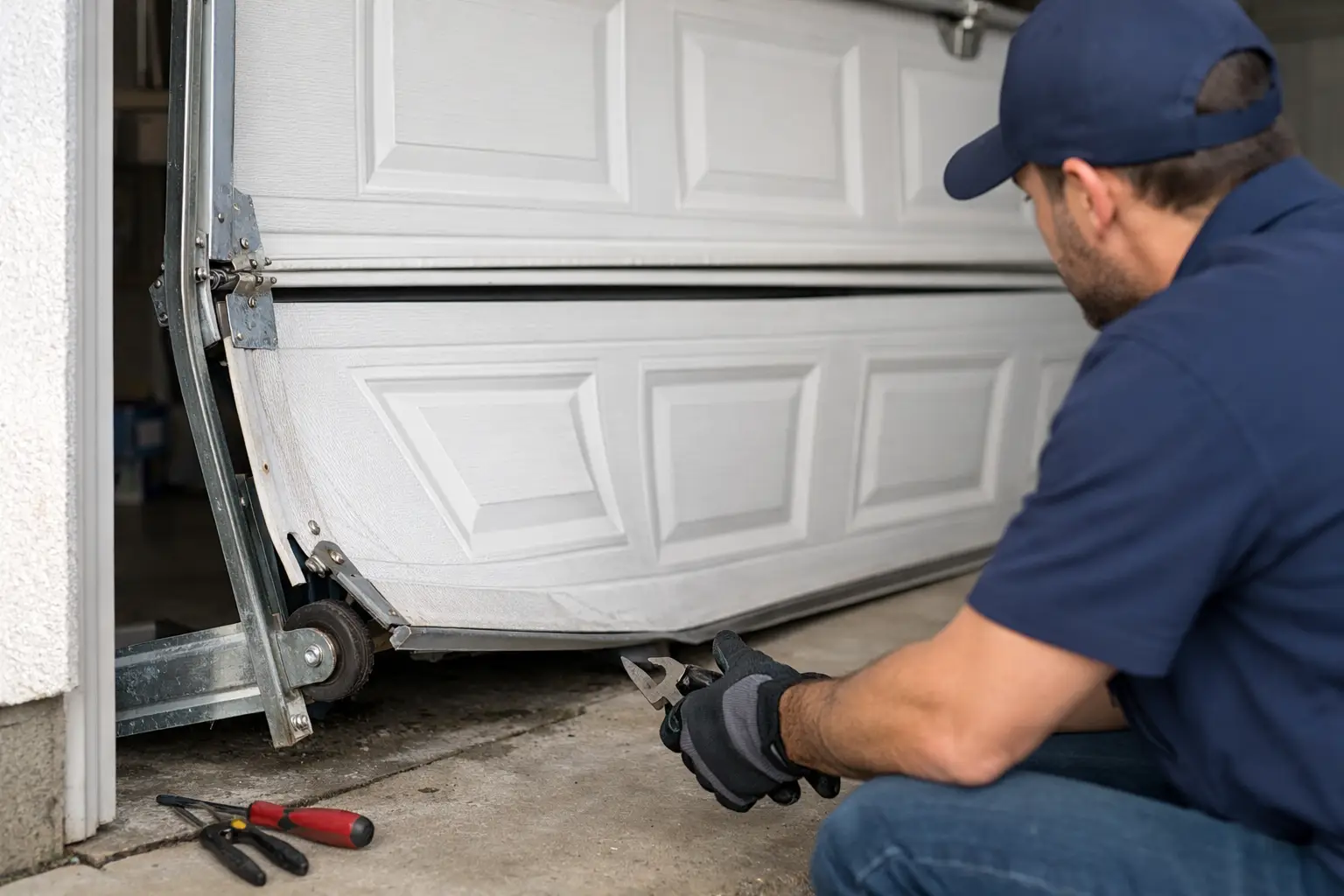
A garage door that jumps the track usually makes itself known fast - a loud bang, a crooked door, rollers hanging loose, or a door that stops halfway and looks twisted. When that happens, garage door off track repair becomes less of a maintenance question and more of a safety issue. A door that is out of alignment can jam shut, hang open, or put extra strain on cables, rollers, hinges, and the opener.
For most homeowners, the biggest concern is simple: can this be fixed today, and is it safe to touch? The honest answer is that it depends on how badly the door came off track and whether the spring and cable system is still under tension. Some minor alignment issues can be corrected by a trained technician fairly quickly. A more serious derailment, especially on a heavy double door, can turn dangerous fast if someone tries to force it.
What causes a garage door to come off track?
Most off-track doors do not happen out of nowhere. There is usually a chain of wear, impact, or neglect behind it. Sometimes a car bumps the lower panel on the way out. Sometimes a roller wears down, a cable loosens, or a bent track slowly gets worse until the door finally slips out.
In Northern Colorado, weather can also play a part. Cold snaps can stiffen old rollers, and wind can push against a door that is already struggling with balance issues. If the opener keeps pulling a door that is binding, the problem can go from annoying to urgent in one cycle.
A few common causes show up again and again. Bent vertical tracks are a big one, especially after impact. Broken or frayed lift cables can pull one side unevenly and yank rollers out of place. Worn rollers, loose brackets, damaged hinges, and broken springs can all create enough imbalance for the door to derail. In commercial settings, high-cycle wear and forklift contact are frequent causes.
Signs you need garage door off track repair right away
Some door problems can wait a day or two. An off-track door usually should not. If the door is visibly crooked, one side is lower than the other, or rollers are outside the metal track, stop using it. The same goes if the door makes grinding sounds, binds hard when moving, or looks like the cables are slack on one side.
Another red flag is when the opener runs but the door does not move correctly. That often means the opener is still trying to do its job while the door hardware is failing underneath it. Continuing to press the wall button or remote can bend panels, strip gears, and make the final repair more expensive.
If your vehicle is trapped inside, it is tempting to muscle the door open. That is where a lot of damage happens. Garage doors are heavy, and when the track, rollers, springs, or cables are no longer working together, the weight shifts in unpredictable ways.
What not to do when a garage door is off track
The safest first step is also the simplest: stop operating the door. Do not keep testing it to see if it will reset itself. Do not pull the emergency release unless you understand the door's condition and can control the weight safely. And do not loosen track bolts, bottom brackets, or cable hardware if torsion springs are still loaded.
This is the part many online videos gloss over. Garage doors are not just panels and wheels. They are tension systems. A roller popping out may look minor, but if that happened because a cable slipped or a spring broke, the repair is no longer a basic adjustment.
There is a difference between spotting the issue and fixing it. Homeowners can usually do the first part safely. The second part should be handled with care.
How garage door off track repair is actually handled
A proper repair starts with figuring out why the door came off track in the first place. Putting rollers back in without addressing the cause is a short-term fix at best. A good technician will inspect the tracks, rollers, hinges, cables, brackets, spring system, and opener before resetting anything.
Step 1: Secure the door
If the door is partially open or hanging unevenly, it has to be stabilized first. This protects both the technician and the door from dropping or twisting further.
Step 2: Check for hidden damage
Tracks may be bent at the bottom where a car tire or bumper clipped them. Rollers may have cracked stems. Cables may be frayed, stretched, or off the drum. In some cases, the panel itself is bent enough that the door no longer moves squarely.
Step 3: Reset and realign the system
Once the damaged parts are identified, the rollers can be guided back into the track, the track can be reshaped or replaced, and the hardware can be tightened or swapped out. If the spring balance is off, that has to be corrected too, or the same problem can happen again.
Step 4: Test door balance and travel
After the visible repair is done, the door should be cycled by hand and with the opener. This confirms the door is moving evenly, the opener is not overworking, and the safety reverse is still functioning properly.
Can you fix an off-track garage door yourself?
Sometimes people ask this because the door only came out on one side and the track does not look badly damaged. In a very limited case - light door, no spring damage, no cable issue, no bent panel - a handy homeowner might be able to spot the misalignment. But that is not the same as a reliable repair.
The real issue is risk. If the door is under load, if a cable is loose, or if the bottom fixture is involved, the repair can become hazardous quickly. The cost of replacing a bent panel, broken opener rail, or damaged spring system usually outweighs the savings of a do-it-yourself attempt.
For that reason, most off-track calls are best treated as service calls, not weekend projects.
What affects repair cost?
Price depends on what failed, not just the fact that the door is off track. A simple reset with minor track adjustment is very different from a repair that also needs new rollers, cable replacement, hinge work, or section replacement.
Single-car steel doors are usually simpler than oversized insulated doors or commercial overhead systems. If the opener was forced while the door was jammed, there may be extra work there too. Emergency timing can also matter, especially for after-hours service when a door is stuck open and the building cannot be secured.
The best service companies will tell you what is damaged, what is optional, and what cannot be safely postponed. That kind of clear, upfront explanation matters more than a low phone quote that changes once the truck arrives.
Why fast repair matters
An off-track door rarely gets better by sitting. Rollers can wear flat, tracks can bend more, and a strained opener can fail next. If the door is open, security and weather become immediate issues. If it is closed with a car trapped inside, the problem affects your whole day.
That is why same-day service matters for this kind of repair. In many cases, a stocked service truck can handle the reset and replace common wear parts in one visit. That saves time and helps avoid the temporary patch jobs that lead to repeat calls.
For local homeowners in Greeley, Evans, Windsor, and Ault, response time is not just a convenience point. It is the difference between a contained repair and a larger headache.
How to reduce the chance of it happening again
Most off-track situations leave clues before the failure. A door that shudders, rubs, squeals, or looks uneven is asking for attention. Regular maintenance helps catch loose hardware, worn rollers, cable wear, and track alignment issues early.
It also helps to keep the track area clear. Small obstructions, built-up debris, and accidental impacts near the lower track can create the starting point for a derailment. If a door has been hit by a car, even lightly, it is smart to have it checked before the next few cycles turn a bend into a breakdown.
If your door is older and already has multiple worn parts, repair versus replacement becomes a fair conversation. Sometimes a straightforward repair is all that is needed. Sometimes the off-track event exposes a bigger pattern of aging hardware. The right answer depends on the condition of the full system, not just one roller out of place.
When a garage door comes off track, the safest move is usually the simplest one: stop using it, keep people clear, and get it looked at before the damage spreads. A good repair should do more than get the door moving again - it should leave you confident that the next time you hit the remote, the door works like it should.