
You usually notice a remote problem at the worst time - when you're late for work, it is dark outside, or the garage door is stuck closed with your car inside. In many cases, garage door remote programming is not complicated. The hard part is figuring out whether the remote actually needs programming, a battery, a reset, or a full opener repair.
That distinction matters. A lot of homeowners assume the remote is the problem when the opener itself is losing signal, the wall button is failing, or the logic board is starting to go. If you know what to check first, you can save time and avoid replacing parts you did not need.
When garage door remote programming is actually the fix
A remote usually needs to be programmed after you replace it, buy a new opener, erase old devices from the opener memory, or lose sync after a power issue. Sometimes it also comes up when you move into a home and want to clear out old remotes for security.
If the wall button still opens the door but the handheld remote does nothing, programming is a reasonable first step. The same goes for a new remote that has never worked with your opener before. But if the remote works only from a few feet away, opens the door only part of the time, or starts acting up during cold weather, that points to a different issue.
Weak batteries are the simplest possibility. Interference is another common one, especially if you recently added LED bulbs, a camera, or another device near the opener. Antenna damage, worn receiver components, and failing circuit boards can all look like a programming problem at first.
How garage door remote programming usually works
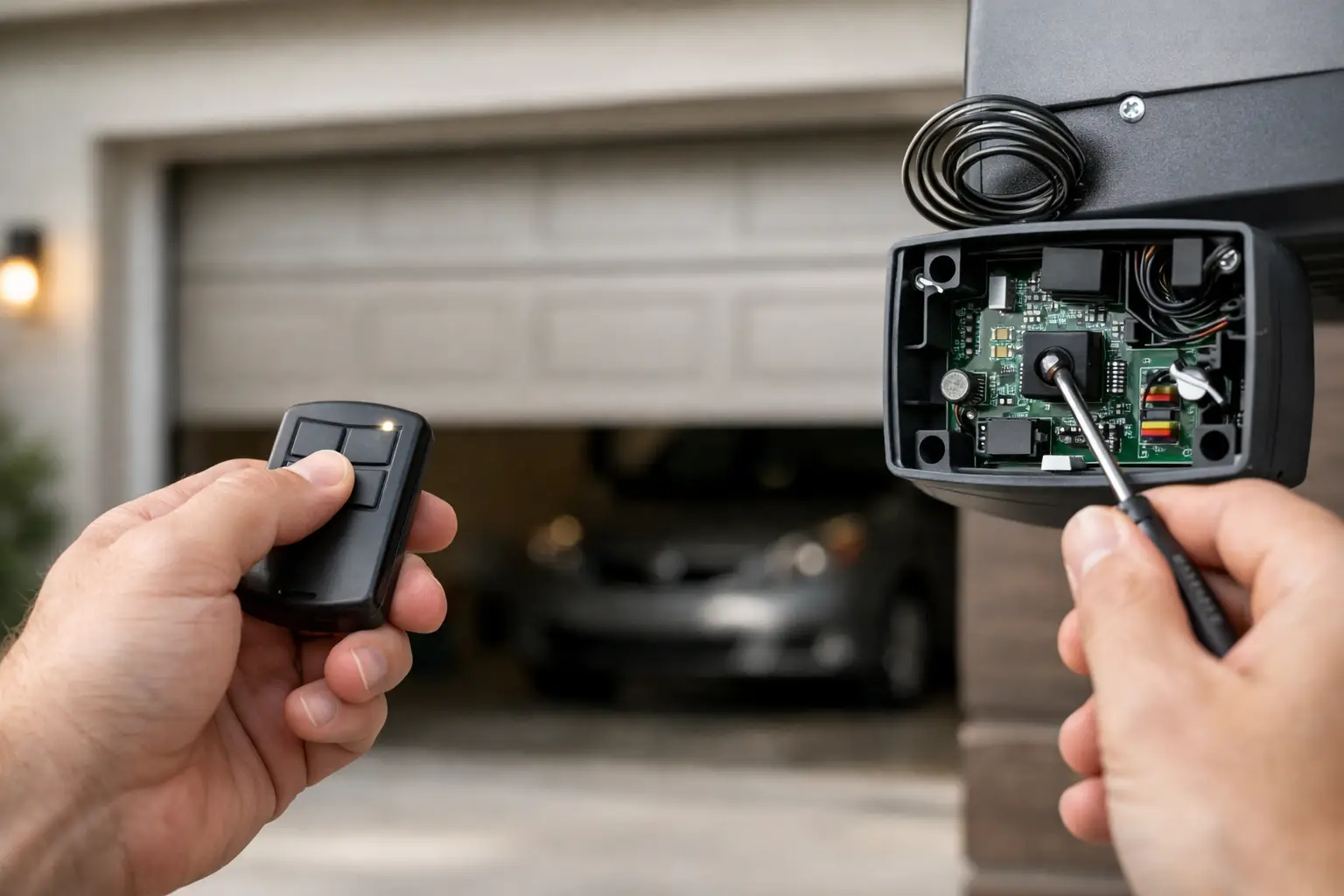
Most modern openers use a learn button on the motor unit mounted to the ceiling. The basic process is simple. You press the learn button on the opener, wait for the indicator light, then press the button on the remote you want to pair.
That is the general idea, but the exact timing and button sequence depend on the opener brand and age. Some systems give you 30 seconds to pair the remote. Some require holding the remote button until the opener light blinks. Others use dip switches instead of a learn button, which is more common on older units.
The biggest mistake people make is moving too fast and not confirming what type of opener they have. Before you start, check the opener head for the brand name, model number, and button color. That little detail can make the difference between a two-minute fix and twenty minutes of frustration.
Start with these basic checks
Before programming anything, replace the remote battery with a fresh one. Do not assume the battery is good just because the remote light comes on. A weak battery can still light the LED and fail to send a strong signal.
Next, test the wall control. If the wall control does not operate the door reliably, stop there. Programming the remote will not solve an opener, power, or safety sensor issue.
Also make sure the opener is plugged in, the breaker has not tripped, and the door is not manually disconnected from the opener trolley. That last one gets overlooked all the time after a power outage or emergency release pull.
A practical step-by-step approach
If your opener has a learn button, stand on a secure ladder and locate it on the back or side of the motor unit. Press and release the learn button. Do not hold it too long unless your opener instructions say to, because on many models that clears existing programming.
Once the opener enters pairing mode, press the button on your remote. You may need to hold it for a second or press it twice depending on the model. Look for a light flash or listen for a click from the opener. That usually confirms the remote has been accepted.
Then test the remote from the ground. If it works, program any additional remotes one at a time. If it does not, repeat the process carefully and pay attention to whether the opener is actually entering learn mode.
For older openers with dip switches, the remote and opener need matching switch positions. In that case, programming is less about pairing and more about making sure the tiny switch pattern matches exactly. One switch out of place means the remote will not work.
Common reasons programming fails
The first is using the wrong remote. Not every remote is universal, and even universal remotes do not work with every opener year and frequency. Compatibility matters more than people expect.
The second is accidentally erasing all remotes from the opener memory. If someone held the learn button too long, every remote may need to be reprogrammed, not just the one in your hand.
The third is a signal problem rather than a programming problem. If a remote programs successfully but still only works inconsistently, the opener receiver, antenna, or surrounding electronics may be interfering with the signal.
There is also the possibility of a bad remote straight out of the package. It happens. If you have followed the correct process and a second known-good remote still works while the new one does not, the remote itself may be defective.
Security matters more than convenience
Programming a remote is not just about making the button work. It is also a security step. If you lost a remote, bought a home, changed tenants, or had work vehicles with opener access, it is smart to clear the opener memory and reprogram only the remotes you still control.
That way, an old remote is not floating around with access to your garage. For homeowners, that protects vehicles, tools, and the entry point into the house. For small commercial spaces, it helps control who can open the door after staffing changes.
This is one place where guessing is not ideal. If you are not sure whether your opener memory was cleared properly, it is worth verifying. A garage door is one of the largest access points on the property, so convenience should not come ahead of basic security.
When the issue is really the opener
If you have to stand right under the opener for the remote to work, that usually is not a programming issue. It may be a weak battery, but it can also mean the antenna wire is damaged or tucked up where it cannot receive signal well.
If the opener clicks but the door does not move, the remote is likely fine. The problem may be a stripped gear, a broken spring, a disconnected trolley, or a door that is too heavy for the opener to lift. In that case, reprogramming the remote will not get the door moving.
If the door reverses immediately or only moves a few inches, look at the photo eyes and travel settings. Again, those are opener or safety system issues, not remote pairing problems.
That is why a quick diagnosis matters. The remote is just one piece of the system. Treating every failure like a remote issue often delays the real repair.
DIY makes sense sometimes - and sometimes it does not
If you are working with a newer opener, have the correct remote, and the door is otherwise operating normally, doing the programming yourself is reasonable. It is a small job, and many homeowners can handle it in a few minutes.
But if the opener is older, the brand is unclear, the ladder setup feels unsafe, or you are dealing with mixed symptoms, calling a pro can save a lot of hassle. The same goes for doors tied into keypads, vehicles, smart home systems, or commercial access controls. The more devices involved, the easier it is for one setting to affect another.
There is also a practical point here. If your garage door is already showing signs of a bigger problem, you do not want to spend half an hour programming remotes for an opener that is about to fail. A service call can sort that out fast and tell you whether you need a simple pairing, a receiver replacement, or a full opener upgrade.
A better result than trial and error
Around Greeley, we see plenty of remote issues that started as a simple battery change and turned into guesswork because the opener had a separate fault. The quickest fix is not always the one that looks obvious first.
If your remote stopped working all at once, start with the basics. Check the battery, test the wall control, confirm the opener model, and try the correct programming process once. If it still does not respond, there is a good chance the problem is deeper than pairing.
A garage door should open when you press the button, not after three tries, a dead sprint to the driveway, or a lot of language the neighbors do not need to hear. If remote programming solves it, great. If not, getting the right diagnosis early usually saves money and frustration.