


You usually do not notice your garage door springs until the morning your car is trapped inside and the door will not budge. That is why knowing the garage spring failure warning signs matters. Springs do the heavy lifting every time the door opens and closes, and when they start wearing out, the door often gives you clues before the full break happens.
If you catch those clues early, you may avoid a dangerous failure, damage to the opener, or a door that slams shut. If you ignore them, a small repair can turn into a bigger and more expensive problem.
Why garage spring problems get serious fast
A garage door can weigh well over a hundred pounds, and the spring system is what makes that weight manageable. Whether your door uses torsion springs above the opening or extension springs along the tracks, those parts are under high tension. When a spring weakens or breaks, the whole system gets thrown off.
That can show up as a door that feels heavy, moves unevenly, or stops responding the way it used to. It can also create a safety issue for anyone walking under the door or trying to force it open. For homeowners, that means hassle and risk. For small businesses, it can mean lost time, blocked deliveries, or a door left unsecured.
9 garage spring failure warning signs to watch for
Some spring failures happen suddenly, but many start with smaller symptoms. Here are the signs that should get your attention.
1. The door feels unusually heavy
If you pull the emergency release and the door suddenly feels much heavier than normal, the springs may not be carrying the load they should. A healthy spring system helps the door lift with relative ease. When that support starts fading, you feel the difference right away.
This is one of the clearest warning signs because the opener may still move the door for a while, making it look like everything is fine. In reality, the opener could be overworking to compensate.
2. The garage door only opens a few inches
A door that starts to open and then stops, especially after lifting just a few inches, often points to a broken or failing spring. Many openers are designed to stop when they detect too much resistance. That is a good thing, because it can prevent further damage.
People sometimes assume the opener is the issue, but the spring system is often the real problem. If the motor hums but the door does not rise properly, do not keep hitting the wall button.
3. You heard a loud bang from the garage
A broken torsion spring can make a surprisingly sharp popping or banging sound. Many homeowners describe it as sounding like something fell or even like a firecracker going off in the garage.
If you hear that noise and the door starts acting differently afterward, stop using it until it is inspected. That sound often means the spring has snapped under tension.
4. The door looks crooked or uneven
When one side of the door rises faster than the other, or the door hangs at an angle, the spring system may be out of balance. This can happen when one extension spring fails, when hardware wears unevenly, or when a spring is close to the end of its cycle life.
An uneven door should never be ignored. It can put extra strain on cables, rollers, and tracks, and it raises the chance of the door coming off track.
5. There is a visible gap in the torsion spring
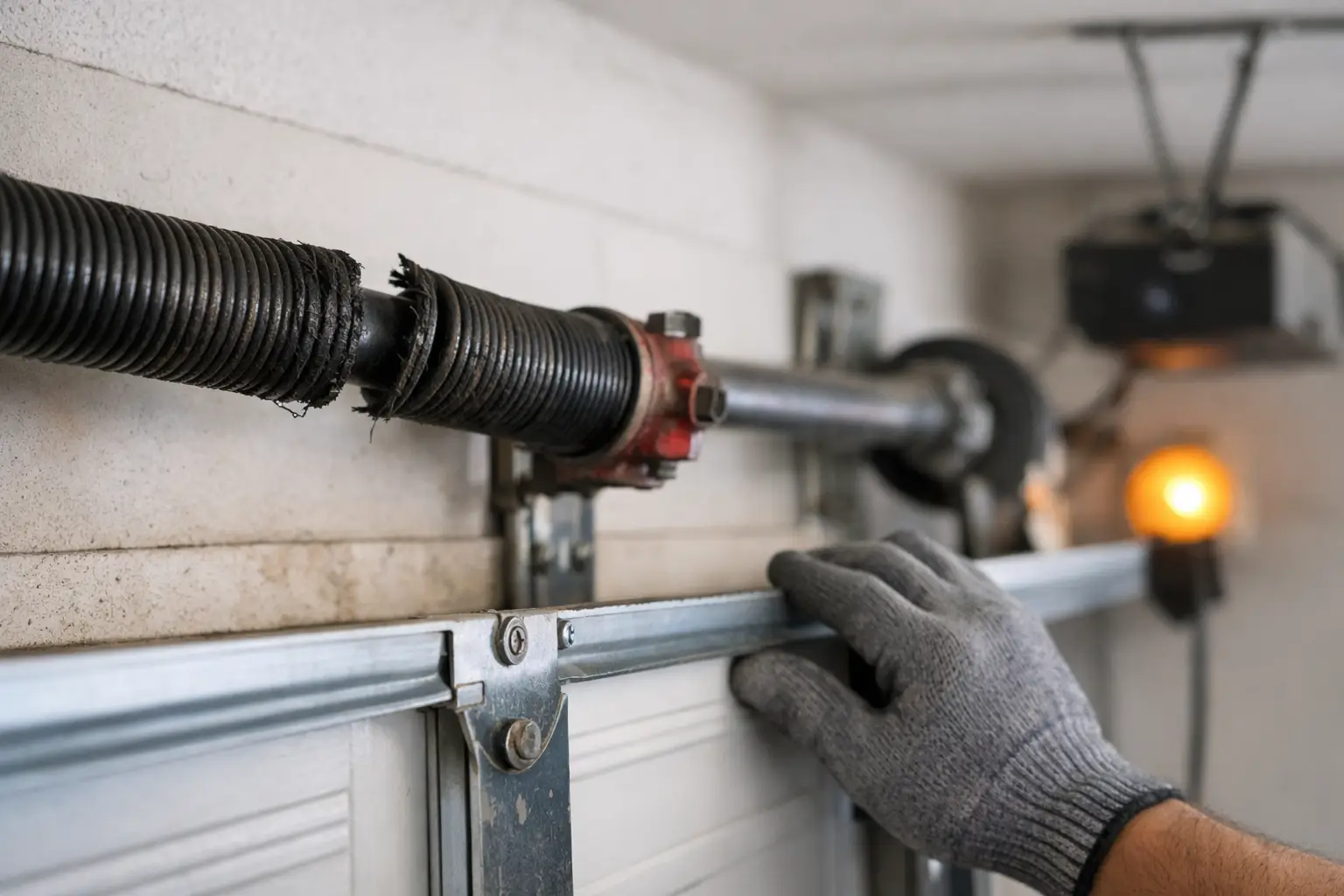
With torsion springs, one of the easiest garage spring failure warning signs to spot is a visible separation in the coil. A broken spring will often leave a gap of a couple inches where the metal has snapped.
If you see that gap above your garage door, the spring is broken. At that point, the fix is not adjustment. It is replacement.
6. The opener strains, jerks, or sounds louder than usual
Garage door openers are not meant to do the heavy lifting on their own. If your opener suddenly sounds louder, jerks during operation, or seems to struggle, a weak spring may be behind it.
This is where waiting can cost you more. A worn spring can turn into a burned-out opener, damaged gear set, or bent top section if the system keeps trying to operate under too much load.
7. The door closes too fast
A door that drops quickly instead of lowering in a controlled way can mean the springs no longer have enough tension to support it. That is a real safety concern, especially in homes with kids, pets, or frequent foot traffic through the garage.
Even if the door still opens, fast closing is a sign the balance is off. It should be checked before someone gets hurt or the bottom section gets damaged.
8. You see stretched, rusted, or worn springs
Not every failing spring breaks cleanly overnight. Sometimes the warning signs are visible. Extension springs may look stretched out. Torsion springs may show rust, thinning, or wear around the coils.
Rust by itself does not always mean immediate failure, but it can speed up wear and reduce the spring's lifespan. In Northern Colorado, changing temperatures and moisture can add to that stress over time.
9. The door no longer stays halfway open
A properly balanced garage door should stay in place when opened halfway by hand. If it falls closed or shoots upward, the spring tension is off.
This test can reveal a balance issue before a complete break happens, but it should be done carefully and only if the door is otherwise operating normally. If the door already seems unstable, leave it alone and call for service.
What causes springs to fail
The most common reason is simple wear. Springs have a limited cycle life, which means they are only designed to open and close the door a certain number of times. If your household uses the garage as the main entrance, that life gets used up faster than many people expect.
Weather also plays a role. Cold snaps can make older metal more brittle, while rust and lack of lubrication speed up deterioration. In some cases, the wrong spring was installed in the first place, or only one spring was replaced when the pair should have been changed together. That can leave the system unbalanced and shorten the life of the remaining parts.
What you should not do
If you suspect a spring problem, do not keep cycling the opener to see if it clears up. Do not try to lift a heavy door by force, and do not attempt a spring adjustment without the proper tools and training.
Garage door springs are one of the few home repair parts that can seriously injure someone in a split second. DIY videos make the job look simple. It is not simple when the metal is under tension and the door weight is involved.
When to call for professional repair
If the door is stuck, crooked, unusually heavy, or making harsh noises, it is time to get it checked. The sooner you do that, the better chance you have of preventing damage to the opener, cables, rollers, and track system.
For many homeowners, the practical question is whether a repair can wait a few days. Sometimes it can, if the door is closed and secure and you are not using it. Often it should not, especially if the door is partly open, off balance, or creating a safety issue. A service technician can tell you quickly whether you are dealing with a worn spring, a full break, or another issue that only looks like spring failure.
At Greeley Garage Door Repair by Mike, this is the kind of problem we see every week. Most customers are not looking for a long technical explanation. They want to know what failed, what it costs to fix, and how fast someone can get there. That is the right approach with spring issues.
A quick note for homeowners and property managers
If your garage door is older, preventive maintenance is worth considering before there is a breakdown. A simple inspection can catch weak springs, frayed cables, worn rollers, and balance issues before they turn into an emergency call.
That does not mean every older spring needs immediate replacement. It depends on the door's age, usage, condition, and whether the system is still operating safely. But if you are already seeing multiple garage spring failure warning signs, waiting rarely improves the outcome.
A garage door should open smoothly, stay balanced, and sound fairly predictable. When it starts acting heavy, crooked, loud, or jumpy, take that seriously. Those little changes are often the door's way of telling you a spring is close to giving out.