
A garage door usually forces the decision fast. One morning it opens halfway and groans. That night it will not close at all. When homeowners ask whether to repair or replace garage door issues, they are usually not looking for theory. They want to know what is safe, what is worth paying for, and what will keep the house secure without wasting money.
The honest answer is that it depends on the age of the door, what actually failed, and how often problems keep coming back. A lot of garage door issues look worse than they are. A broken spring, worn rollers, frayed cables, or an opener problem can make the whole system feel finished when the door itself is still in good shape. On the other hand, some doors have reached the point where another repair only delays a full replacement by a few months.
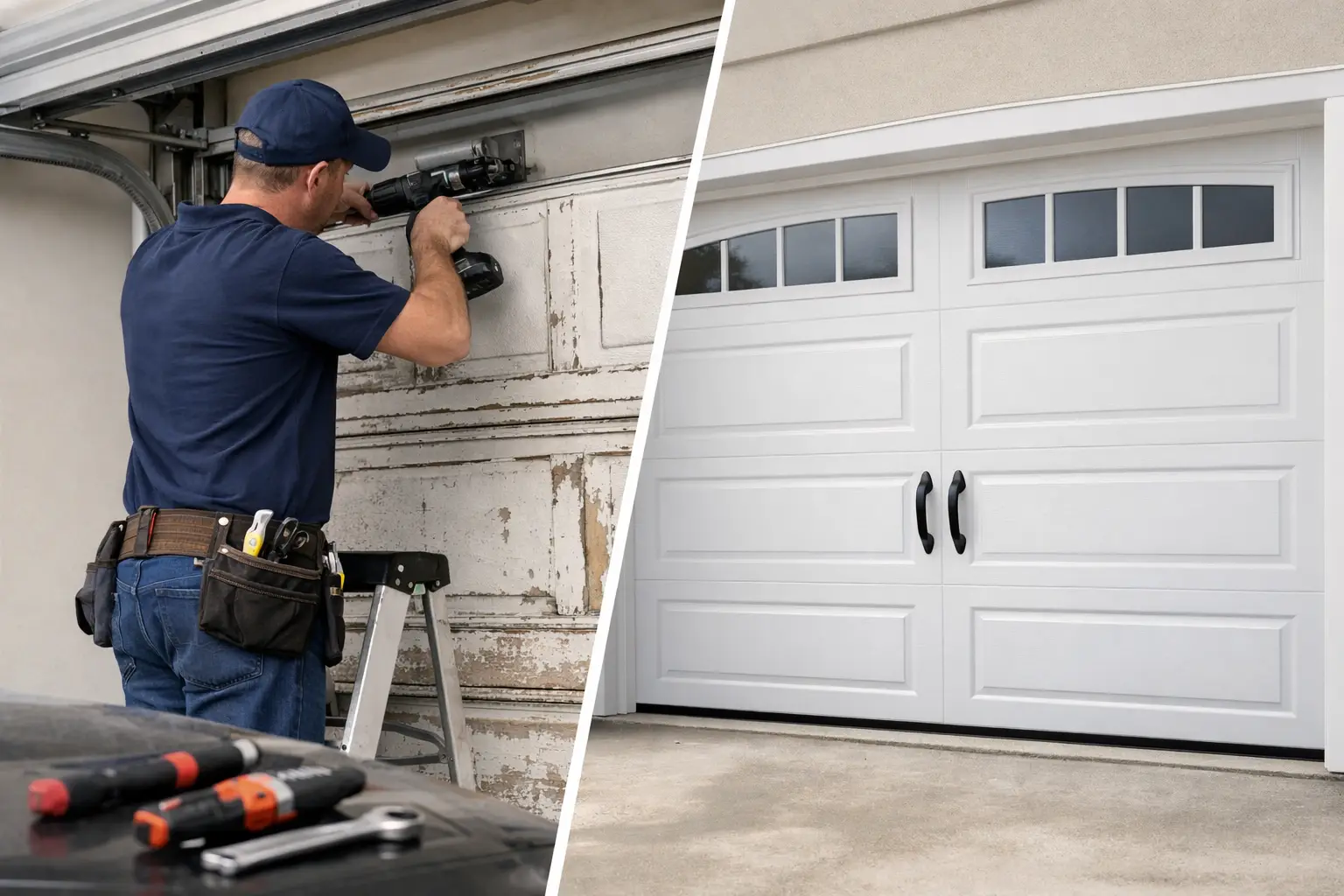
How to decide: repair or replace garage door problems
Start with the part that failed. Not every garage door problem means the entire door is bad. In many cases, the door panels, track, and hardware are still serviceable, and the real issue is one major wear item.
Springs are a good example. A torsion spring does a lot of the lifting, and when it breaks, the door may feel impossibly heavy or stop moving altogether. That is a repair situation, not automatically a replacement situation. The same goes for cables, rollers, hinges, sensors, and many opener failures. These are common service calls, and when handled correctly, they can give the door more useful life.
Replacement makes more sense when the structure of the door is compromised. If multiple panels are bent, the track is badly damaged, the door is out of alignment from impact, or the bottom section has significant rot or rust, the cost of stacking repairs starts to get hard to justify. You can fix one issue. You can even fix two. But when several core parts are failing together, replacement often becomes the more practical choice.
When repair is usually the smarter move
If your garage door is under 10 to 15 years old and the problem is isolated, repair is often the better value. A quality door does not need to be thrown out because one spring snapped or the opener started acting up.
Repairs also make sense when the door matches the home well, the panels are still available, and the system has not been a repeat trouble spot. Homeowners in Northern Colorado often deal with temperature swings, wind, and day-to-day wear that shorten the life of moving parts. That does not always mean the whole door is done. It may simply mean the working components need attention.
A repair-first approach is especially reasonable if the issue involves:
- broken torsion or extension springs
- worn rollers or hinges
- frayed or broken cables
- sensor alignment problems
- opener motor, gear, or remote issues
- a door that came off track without major panel damage
Those are all real problems, and some are urgent, but they do not automatically call for a new door. In many homes, a same-day repair gets everything back to normal without the higher cost of replacement.
When replacing the garage door is the better call
There is a point where repairs stop being cost-effective. If your door is older, noisy, uninsulated, dented in multiple sections, and showing repeated hardware failures, replacement can save money over time.
One major factor is panel damage. If only one section is bent, a panel replacement may be possible. But if matching panels are discontinued or the impact twisted other parts of the system, that repair can become a patch job. At that point, a new door may look better, run better, and come with a stronger warranty.
Energy efficiency matters too. Older garage doors often have little to no insulation. If your garage is attached to the house, that can affect comfort in nearby rooms and put more strain on heating and cooling. Replacing an old door with an insulated model is not just a cosmetic upgrade. For many homeowners, it improves noise control, durability, and day-to-day comfort.
You should also lean toward replacement if the door has become a safety concern. Sagging sections, cracked hinges around mounting points, severe rust, and repeated balance problems are signs the system may not respond well to another basic repair. A garage door is the largest moving part in most homes. If it is unstable, this is not the place to gamble.
Cost matters, but so does the pattern
Most people make this decision based on price first, which makes sense. Repair usually costs less upfront than replacement. But the better question is not just what today costs. It is what the next year is likely to cost.
If you put money into spring replacement today, then need cable work in three months, opener repair in six months, and panel work after that, the lower initial bill stops looking like savings. That does not mean every older door should be replaced. It means recurring repairs should be treated as a pattern, not as separate events.
A good technician should be honest about that pattern. If the door has solid life left, you should hear that. If you are spending money on a system that is wearing out across the board, you should hear that too. Straight answers matter more than a sales pitch.
Safety should weigh heavily in the decision
Some garage door failures are inconvenient. Others are dangerous. Broken springs and cables are under high tension. Doors that are off track can drop or jam. Openers with force-setting issues can behave unpredictably. Even a door that technically still moves may not be safe to keep using.
That is one reason this decision should start with an inspection, not a guess. A door can look repairable from the driveway and still have hidden wear at the bearing plates, brackets, drums, or track mounts. If the system cannot be returned to safe operation with a reasonable repair, replacement becomes the responsible call.
This matters even more if the garage is your main entry point, if kids are in and out of that space, or if the building stores work vehicles and equipment. Reliability is not just convenience. It is access, security, and safety.
Signs your garage door is trying to tell you something
A garage door usually gives warnings before total failure. Homeowners often notice loud popping sounds, uneven movement, slow response, or a door that shakes on the way up. Those are not normal aging noises to ignore.
If your door feels heavier than it used to, stops halfway, reverses for no clear reason, or leaves gaps when closed, something in the system is wearing out. If it has already needed multiple service calls in a short time, that is another clue. One repair is routine. Repeated repairs are information.
This is where the question repair or replace garage door stops being theoretical. The answer shows up in how the system behaves week after week. If repairs restore smooth, reliable function, keep it. If each fix uncovers the next problem, replacement starts making more sense.
What local conditions can change
In places like Greeley, Evans, Windsor, and Ault, weather and dust can be hard on garage door systems. Cold snaps affect springs. Wind can stress tracks and hardware. Daily use adds up fast, especially for households that use the garage as the main front door.
That does not mean every weather-worn door needs replacing. It does mean local use conditions matter. A door on a busy household garage may age very differently from a lightly used detached garage. Commercial doors see even more cycles, which changes the math on repair versus replacement.
A practical service company should account for that, not give every customer the same answer.
The best decision is the one that solves the problem fully
Homeowners usually do best when they ask three direct questions. Is the door safe after repair? Is the repair likely to hold up? And does the cost make sense compared with the age and condition of the door?
If the answer to all three is yes, repair is probably the right move. If the answer starts turning into maybe, especially on an older or damaged system, replacement is often the cleaner and less frustrating option.
At Greeley Garage Door Repair by Mike, that is how we look at it. Not every broken door needs to be sold a brand-new system, and not every aging door should be patched one more time. The right call is the one that gets your garage secure, dependable, and back to working the way it should.
If your door is making the decision for you by getting louder, slower, or less reliable, it is time to have it looked at before a manageable repair turns into an emergency.