
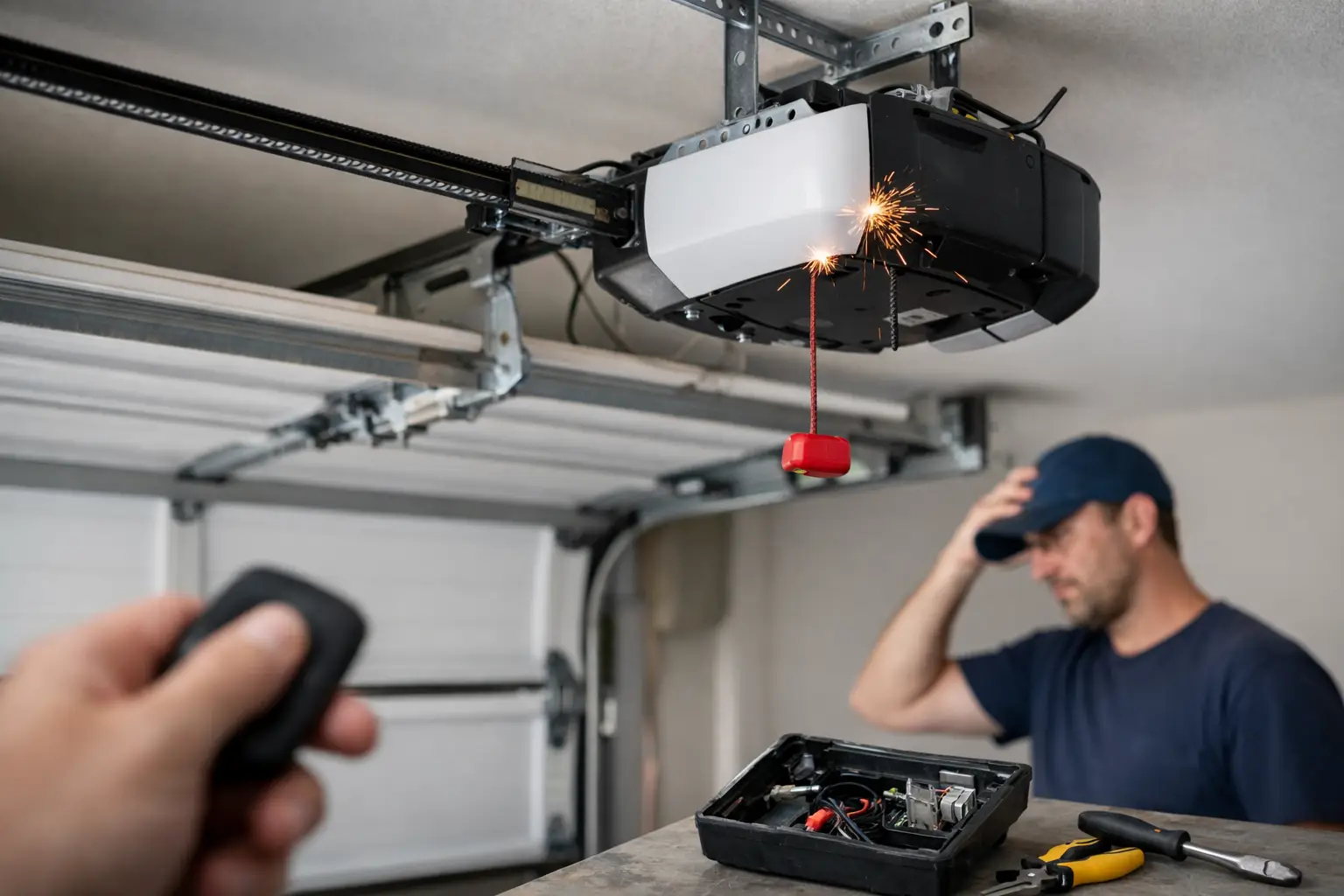
A garage opener usually fails at the worst possible time: when you are late for work, pulling in during a snowstorm, or trying to get a vehicle out for an appointment. The top causes of garage opener failure are not always inside the opener itself. A door that is too heavy, a blocked safety sensor, or a simple power issue can all make a working opener look broken.
The good news is that some problems have safe, simple checks. Others need a trained technician because the garage door system is under serious tension. Knowing the difference can save time, prevent damage, and keep you from getting stuck with a door that will not open or close.
1. Lost Power or a Tripped Outlet
Before assuming the opener motor has failed, check whether it has power. Garage openers plug into a ceiling outlet, and that outlet may be controlled by a tripped GFCI, a breaker, or a loose plug. It is common for an outlet in the garage to stop working after a power surge, heavy storm, or another electrical issue in the home.
Look for lights on the opener unit. If there are no lights and the wall button does nothing, test the outlet with a lamp or another small device. Check your electrical panel and any GFCI outlets in or near the garage. If the outlet works but the opener is still completely dead, the opener's internal transformer, wiring, or control board may be the issue.
Do not run an extension cord across the garage as a permanent solution. It can create a safety problem and does not address the source of the failure.
2. Remote, Keypad, or Wall Button Problems
Sometimes the opener is fine, but the control you use to operate it is not communicating with the unit. A remote with a weak battery is the easy fix. A keypad may need a new battery or may have lost its programming after a power interruption. If one remote works and another does not, the problem is usually with the remote rather than the opener.
The wall button can fail too. A worn button, damaged low-voltage wire, or loose connection can prevent the opener from receiving the signal to move. If the remote works but the wall button does not, avoid taking apart the opener motor. The problem may be as simple as the button or its wiring.
Older openers can also have interference issues. LED bulbs, nearby electronics, and certain wireless devices occasionally interfere with remote signals. This is less common than a dead battery, but it is worth considering when the remote only works from very close range.
3. Misaligned or Blocked Safety Sensors
If your garage door opens normally but starts down and immediately reverses, the photo-eye safety sensors are one of the first things to inspect. These small sensors sit near the bottom of both door tracks. One sends an invisible beam to the other. If that beam is blocked or misaligned, the opener assumes something is in the door's path.
Dirt, spiderwebs, leaves, a trash can, or a child's toy can block the sensors. A bump from a car tire, bike, or storage bin can also knock a sensor out of alignment. Check that both sensor lenses are clean and that their indicator lights are steady, not blinking.
You can gently adjust a loose sensor bracket, but do not bypass the safety system. The sensors are there to prevent injuries and property damage. If the lights will not stay solid after cleaning and aligning them, a technician can check the wiring and sensor condition.
4. Incorrect Travel Limits or Force Settings
Your opener uses travel limits to know when the door has reached the floor or fully opened position. When these settings are off, the door may stop too soon, hit the floor and reverse, or leave a gap at the bottom. Force settings tell the opener how much resistance is acceptable during operation.
These adjustments can change over time, especially after seasonal temperature swings or a repair to the door. Northern Colorado weather can be hard on a garage system. Cold temperatures stiffen lubricants, shifting ground can affect track alignment, and snow or ice near the threshold can create resistance the opener interprets as an obstruction.
Some opener models have clearly labeled adjustment controls, but force settings are not a cure for a binding or heavy door. Turning up the force may make the opener push harder against a mechanical problem, which can strip gears, bend parts, or create a safety risk. If the door is jerky, noisy, or difficult to move by hand, the door needs attention before the opener settings do.
5. A Worn Drive Gear, Motor, or Internal Control Board
Openers have moving parts that wear out. Chain-drive, belt-drive, and screw-drive units all have different strengths, but none last forever. A common internal failure is a worn plastic drive gear. You may hear the motor running while the door does not move, or you may notice grinding or clicking from the opener housing.
A failing capacitor or motor may hum without lifting the door. A damaged logic board can cause inconsistent behavior, such as remotes that work only sometimes, random light operation, or an opener that ignores commands. Lightning, power surges, moisture, and age can all affect electronic components.
Whether repair makes sense depends on the opener's age, condition, and available parts. Replacing a gear on a newer, otherwise dependable unit can be a smart repair. Replacing several electronic parts in an older opener may cost enough that a new opener with updated safety features is the better value. A straightforward diagnosis should come before anyone recommends replacement.
6. A Door That Is Too Heavy for the Opener
This is one of the most overlooked causes of garage opener trouble. The opener is designed to guide a properly balanced garage door. It is not designed to lift the full weight of the door by itself. When a torsion spring breaks or loses tension, the opener has to work far beyond its intended load.
Signs of a balance problem include a door that opens only a few inches, a door that feels extremely heavy when disconnected from the opener, a loud bang from the garage, or cables that look loose or tangled near the drums. The opener may strain, reverse, make a humming sound, or stop working altogether after repeated attempts.
Do not try to adjust, wind, or replace garage door springs yourself. Springs and cables carry high tension and can cause severe injuries when handled incorrectly. Also, do not keep pressing the opener button in hopes that it will force the door up. That can turn a spring repair into an opener repair as well.
A Safe Balance Check
Only perform this check if the door is fully closed and there is no visible broken spring, loose cable, or damaged track. Pull the emergency release cord to disconnect the opener, then lift the door manually a few feet. A balanced door should move smoothly and stay near that position without crashing down or shooting upward.
If the door is hard to lift, will not stay in place, or feels uneven, reconnect it and schedule service. Never stand under a partially open door during this test.
7. Damaged Tracks, Rollers, Cables, or Hinges
An opener can fail because the door cannot travel freely. Bent tracks, seized rollers, worn hinges, frayed cables, and loose hardware add resistance. You may see the door shake, hear scraping metal, or notice one side moving differently from the other.
This is especially relevant after a vehicle bump, a severe wind event, or years of normal wear. Even a small track issue can make the opener work harder every time the door moves. Left alone, that strain can shorten the life of the motor and drive system.
A little garage-door lubricant on appropriate moving parts can reduce normal noise, but lubrication will not fix a bent track, bad roller, or cable problem. Avoid spraying heavy grease on the tracks. Tracks should generally be clean so rollers can move properly.
What to Do When Your Opener Stops Working
Start with the safe basics: check power, replace the remote battery, clear the sensor path, and look for obvious damage. Stop using the opener if the door is crooked, the cables are loose, the spring appears broken, or the door will not move smoothly by hand.
For homeowners in Greeley, Evans, Windsor, and Ault, a local technician can usually identify whether the issue is electrical, mechanical, or both during one visit. Greeley Garage Door Repair by Mike provides clear upfront pricing and repairs stocked from the service truck whenever possible, so you are not left waiting days with a vehicle trapped inside.
A garage opener is only as reliable as the door it is moving. When something changes - new noise, slower movement, repeated reversing, or a door that feels heavy - treating it early is usually the safer and less expensive choice.